The Italian job: Italian alders at Howard Davis Park
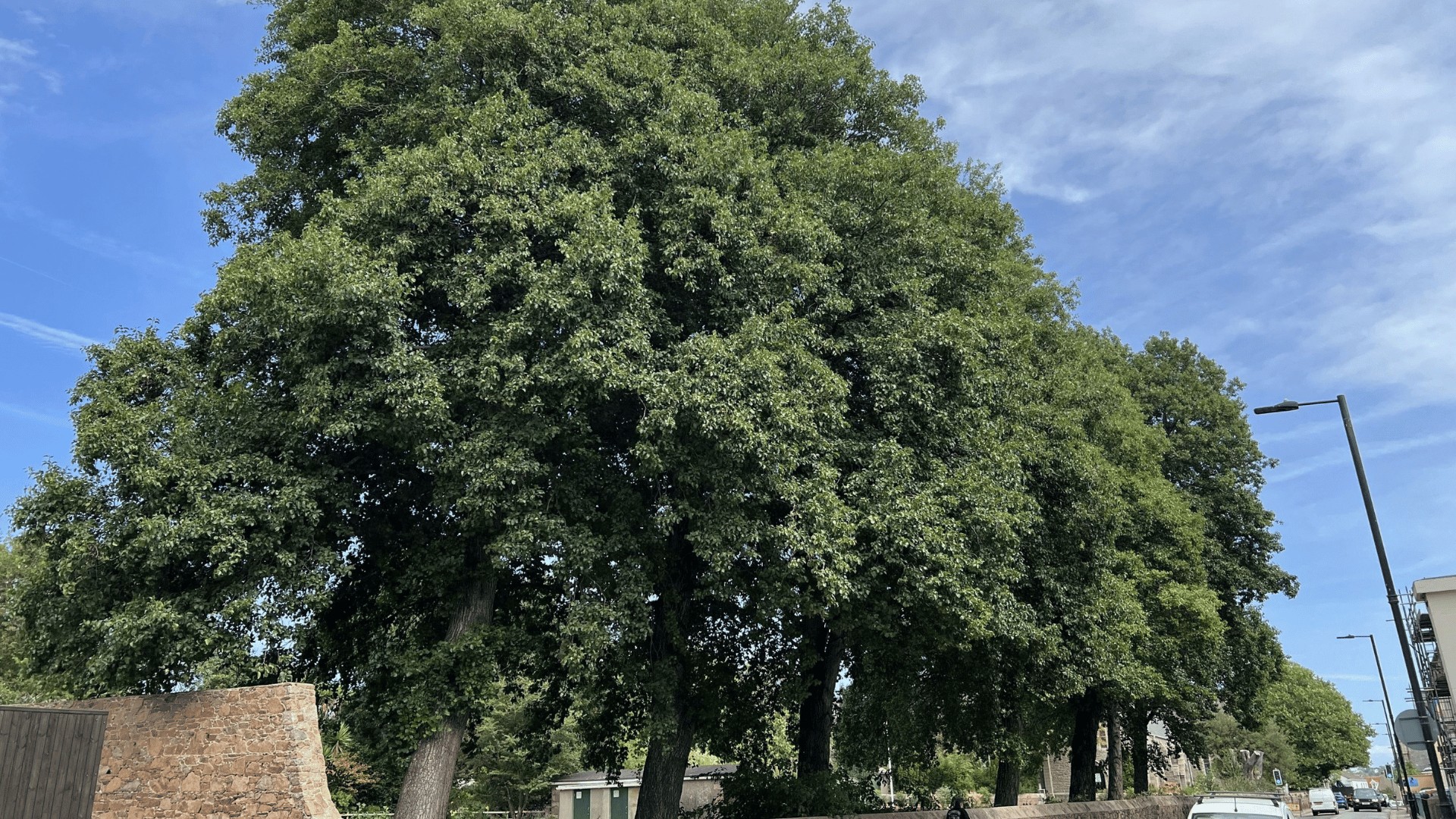
If you know La Route de Fort, you’ll probably have wondered about the large trees lining the road by Howard Davis Park. After all, they’re impossible to miss due to their size and prominence. But what are they and what’s the story?
Back in the 1870s, Howard Davis Park was a private property named Plaisance, comprising a large main house and 25 vergees of grounds. Its owner-resident was Jurat Falle, who found two scamps collecting conkers there one Sunday. One was Thomas Benjamin Davis, future father of Howard and a confident young fellow partial to fruity language.
After being forced to clean the Jurat’s boots in the cellar while he had lunch, Davis faced up to Falle, stating he’d grow up to be rich, buy his house and “pull it down stone by ****** stone”.
Here’s the funny part: he actually did. It’s another story but suffice to say he made his fortune with a stevedoring business in South Africa before returning to Jersey as a wealthy man on a mission to keep his word. And they say women hold grudges.
What about the trees? While some may have been around since the days of Plaisance, this doesn’t apply to the roadside Italian alders (Alnus cordata).
As these trees are around 15-20m tall with a 2-3m metre girth, we can estimate age at 45-75 years. We also know they replaced lost elms, suggesting an origin of Dutch elm disease in the 1970s or 1980s. Regardless, they’ve thrived. Today, the third tree from the east, the tallest and girthiest, is a champion local specimen.
Planting Italian alders made sense as they’re fast-growing, pollution-tolerant and less reliant on water than common alder. They’re favourable to warming climate too. In fact, Alnus cordata is a secondary species, meaning it may one day be treated as primary for its suitability, subject to further research.
Italian alder is part of the Alnus genus in the Betulaceae (birch) family. Native to parts of southern Italy and Corsica, and naturalised in Britain, it can reach 25m in height and exceed 3m in girth over a 60-100-year lifespan. After producing pendulous male and ovoid female catkins in early spring, it hangs on to its heart-shaped leaves until the decorations go up. They do say Italians like to look good. These alders were certainly a good choice. Che bello!
Make a difference
Every donation plants roots for Jersey's future. Support our work today.