In plane sight: Oriental plane at Samarès Manor
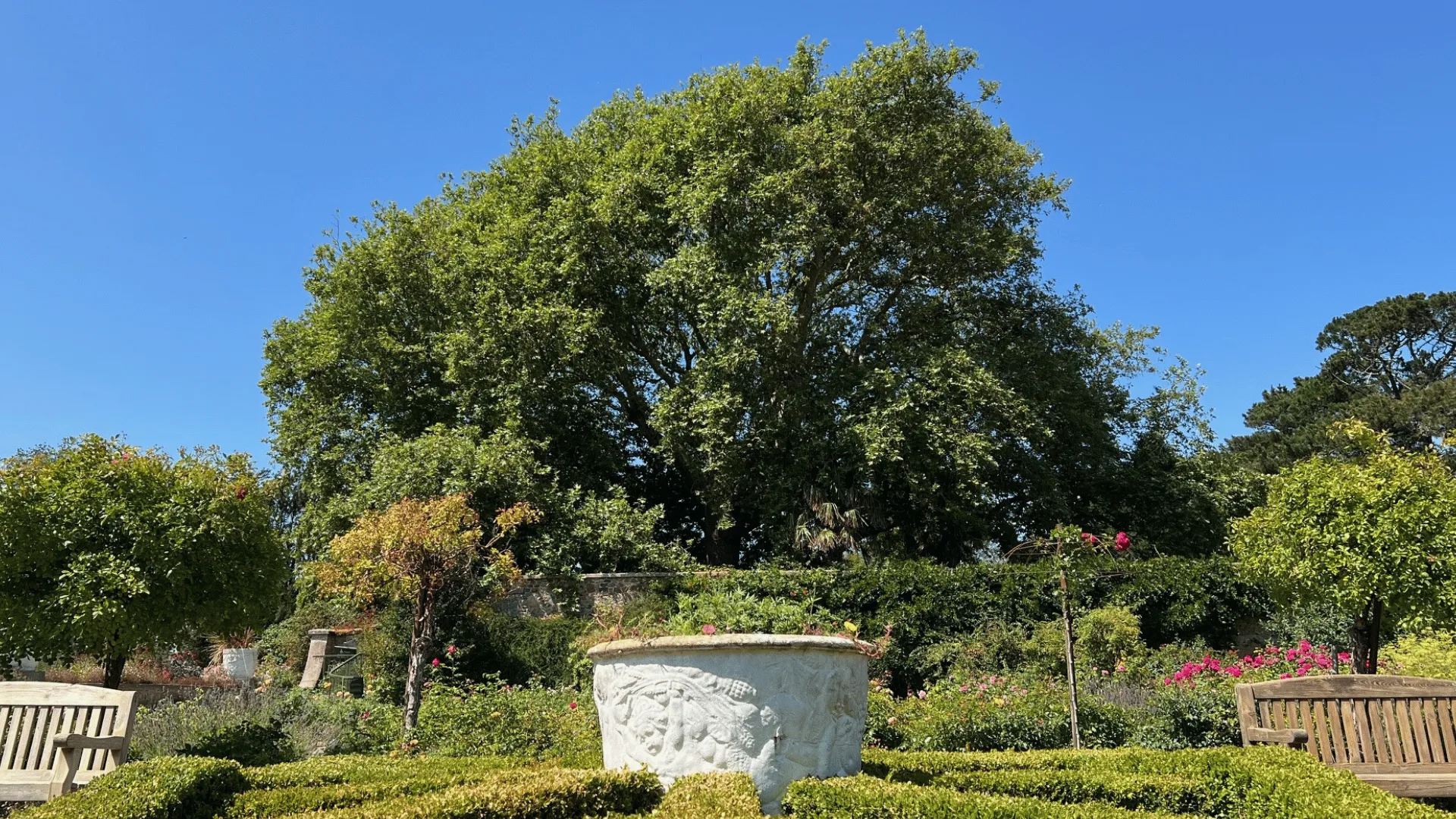
The Botanic Gardens at Samarès Manor are an ideal setting for tree enthusiasts, packed with species from far and wide. Among these stands a mighty Oriental plane (Platanus orientalis), around 22m high with a girth of over 5m, likely over 200 years old and still going strong.
The gardens at Samarès Manor were created in the 1920s by Sir James Knott, a shipping magnate and former MP who moved to Jersey in 1924. The plane was therefore present long before his arrival, having likely been planted in the late 18th or early 19th century, during manor house developments for Seigneur Jacques Hammond.
Once established, the plane thrived in an area known for excellent planting conditions and only exposed to visitors. Today it’s a picture of health, towering above peers and vindicating a botanical choice made over two centuries ago.
Its size is no surprise; Oriental planes are large, typically growing up to 30 metres tall with a hefty crown spread of up to 25 metres and a monster trunk of up to nine metres in girth – a diameter of almost three metres.
Since their introduction to the British Isles from south-east Europe in the mid-16th century, Oriental planes have been outnumbered by London planes, a product of hybridisation with American sycamore that’s now abundant in the UK’s capital.
Much of this comes down to pollution. Oriental planes are resilient but less so than their hybrid offspring in terms of particle absorption. However, they’re similarly effective as shade trees and tolerant of root compaction, both vital urban considerations.
Recognising the species is easy if you can differentiate it from London plane. Both have maple-like leaves and round flowers, with females morphing into spiky, hairy, hanging fruit. However, Oriental plane’s leaves have far deeper-cut lobes, its fruit are smaller and form clusters of up to six (not two) and it doesn’t share the ‘camouflage’ bark pattern of younger London planes.
Oriental planes remain culturally important today, as in Athens and Rome during antiquity, when Pliny the Elder advocated their widespread medicinal use. In India it’s the state tree of Jammu and Kashmir while in Iran many are designated “cultural heritage”, including one in Osku estimated to be 1,200 years old. Theoretically, therefore, the Samarès Manor plane could take a lobed leaf out of its book and stick around until the year 3000.
Make a difference
Every donation plants roots for Jersey's future. Support our work today.