Sacred sentinel: English oak at St Brelade's Church
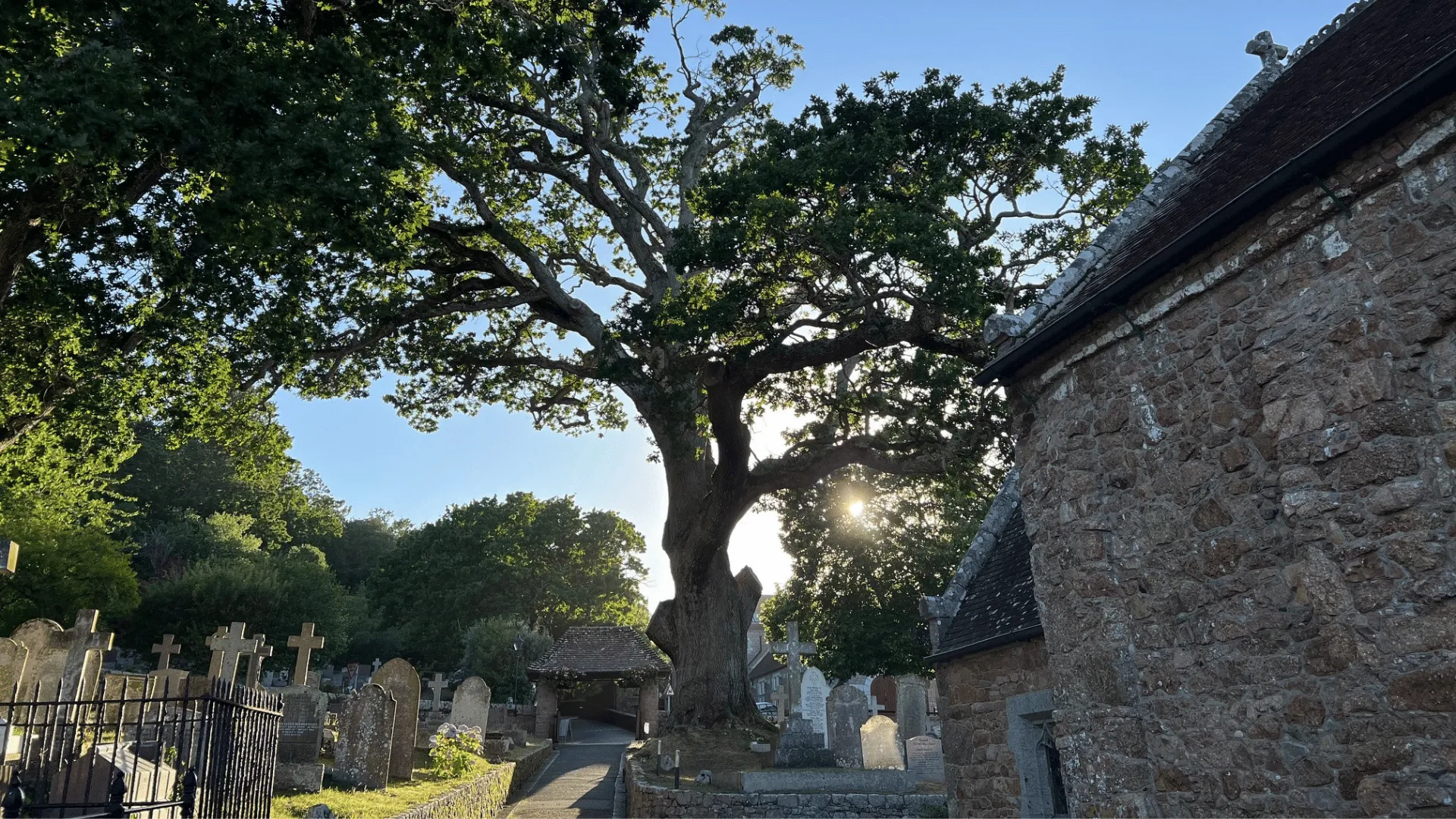
St Brelade’s Church is home to perhaps Jersey’s best-known tree, a veteran English oak (Quercus robur) that has stood overlooking the bay for over 200 years. At 16m it’s not the tallest oak (this species can reach 20-40m) but its mighty girth of over 5.3m paints a different picture of longevity and resilience.
The oak was planted in 1800, under the rectorship of Le Rev. M. George Bertram, during the Napoleonic Wars when Jersey was an island of 20,000 people farming, fishing and exporting cider. On land farmers used hawthorn, blackthorn and elm to shelter their crops and livestock while at sea our fishermen risked their lives heading as far as the choppy cod banks of Newfoundland.
English oak (also known as common or pedunculate oak) takes 20-50 years to mature, so by the second half of the 19th century this tree would have become a prominent feature of the church – a church that was already a sacred site to pious parishioners and a stunning piece of history in its own right, originating as it did before 1035.
Oak (Quercus) is part of the Fagaceae family, like beech (Fagus), and English oak is our best-known species. It has immense cultural importance in England as a national emblem and more widely as a symbol of strength with its spreading crown and thick branches.
Locally it’s one of our two prevailing oaks, along with holm, but unlike its evergreen relative, ‘English’ is a star performer at supporting biodiversity, with 2,300+ UK species counted. This includes hundreds of insect species which attract birds, while the likes of mice and squirrels eat its acorns and birds and bats roost in its holes and crevices.
English oak is an easy spot, thanks to its distinctive leaves with deep, round lobes that appear from mid-April, tinting from late August. Flowers form as long yellow catkins in early May after wind pollination, with fruit (acorns) appearing from mid-August.
Historically oak is linked to royalty (think Roman crowns) and supposedly venerated by the gods. More prosaically its tough timber is used to make high-quality flooring and furniture.
Perhaps most of all, however, oak remains a symbol of strength and longevity, with examples like Cheshire’s Marton Oak proving they can live far beyond a thousand years – making our sacred guardian of St Brelade’s Bay a relative youngster despite being Jersey’s oldest oak.
Make a difference
Every donation plants roots for Jersey's future. Support our work today.